Daquan Griffith


Project Type : Studio ASPEN
Date : September 2023 - April 2024
Role : Studio Executive Producer
Team Size : 50+
-
Game Improvements: Add more enemy variety and introduce dynamic environmental challenges that require quick adaptation.
-
Skills Gained: Advanced movement coding, Unity physics manipulation, player-centric design for skill-based mechanics, Balancing Mechanic implementation vs Player enjoyment with Playtesting
-
Executive personal improvement: Better Jira Management and Task Distribution.

Design & Development Breakdown
-
Concept & Goals: To create a fluid, adrenaline-fueled experience where combat and movement are intertwined, challenging players to combine sword skills and agility.
-
Core Mechanics:
-
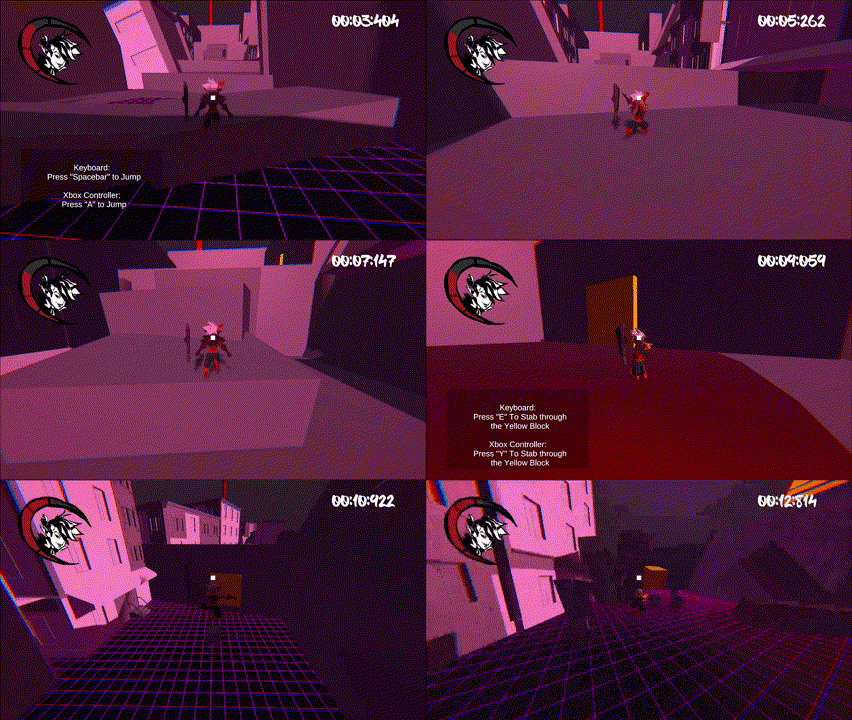
Wall-Slash Climbing: Players slash along walls to ascend vertical surfaces, encouraging creative pathfinding.
-
Design Rationale: Encourages exploration and skillful movement, rewarding players who master the mechanic.
-
Programming Highlights: Developed collision-based detection for wall proximity, triggering climbable surfaces.
-
-
Air-Dashing: Players can dash mid-air to reach distant platforms or evade attacks.
-
Design Rationale: Adds depth to movement and increases the pacing of each level.
-
Programming Highlights: Integrated a cooldown and directional system, ensuring smooth transitions between dashes.
-
-
Momentum Boosts: Powerful ground strikes allow players to gain momentum, crucial for high scores and fluid movement.
-
Design Rationale: Adds layers to the gameplay, rewarding timing and precision.
-
Programming Highlights: Implemented physics-based impulse effects to give the strikes a weighty, impactful feel.
-
-

Design Problems, Solution, and Theory
While I was an Executive Producer, having a background in design and programming allowed me to weigh in on and create certain systems to solve different problems. One of the main problems we kept running into while playtesting was, how player satisfaction(PS) interacts with mechanic mastery(MM) and Speed.
In a game about speed, it might be fun to give the player many tools to choose from that give more speed but adding these tools may reduce the PS and increases MM. When thinking about the game as a whole, PS is the most important and will determine what features stay in and get left out since player experience is most important.

When it came to the implementation and ideation of new mechanics/skills I wanted to rate everything on the three variables. New mechanics would get their score and be sorted out and valued based on the chart to the left.
***Speed is a special variable because either high or low speed can change how we value a new mechanic/skill, seek the chart below.

If a Mechanic/Skill can be Done At/Encourages high speed but requires low mastery that leads to high Player Satisfaction
If a Mechanic/Skill can be Done At/Encourages high speed but requires high mastery that leads to low Player Satisfaction
If a Mechanic/Skill can be Done At/Encourages low speed but requires low mastery that leads to low Player Satisfaction
If a Mechanic/Skill can be Done At/Encourages low speed but requires high mastery that leads to high Player Satisfaction
High Skill Cap
Rare Player High Pay-Off
Too Difficult
Player Frustration
Too Easy
Player Lacks Challenge
Low Skill Cap
Common Player Low Pay-Off
Keeping this in mind between playtests and interactions there was an interesting correlation between adding new mechanics and the increase/decrease in player satisfaction
Here are 3 Iterations as an Example
Iteration 1 - Early Production
New Mechanic/Skill
***Player Satisfaction is an average score and observation values based on playtest every month

Skill : Stab
Player Satisfaction Score
10.4
Being these were the first two core skills the player would use, it was expected that players would feel happy with them
Players struggled to understand the use of the slash compared to the stab so we had to revisit the code and implementation

Skill: Slash
Player Satisfaction Score
8.1
Iteration 2 - Mid Production
Skill : Stab
Skill: Slash
Player Satisfaction Score
9.3
Player Satisfaction Score
11.3
With the addition of a downward slash, players became happier with the slash since they had to use one to do the other
The unintended side effects are that players did not enjoy the stab ability and its usage
While players did enjoy the usage of the downward slash it did help push the understanding of the slash itself
New Mechanic/Skill
Skill : Downward -Slash

Player Satisfaction Score
7.5
Iteration 3 -Late Production
Skill : Stab
Skill: Slash
Skill : Downward -Slash
Player Satisfaction Score
13.3
Player Satisfaction Score
14.4
REMOVED(Added back later in development)
One thing that I learned was removing certain skills can make a big difference in how players learn or see the main mechanics
Removing the downward-slash for this iteration greatly increased player reception and usage of the stab and slash
New Mechanic/Skill
Skill: Energy Blast

Player Satisfaction Score
3.2
Mechanic : Rotating Walls
Adding the energy blast was a very risky move and is a perfect example of a cool mechanic that falls flat in execution
The blast itself was not very player-friendly but the idea of a wall that can rotate if shot by the player was received extremely well by the players

Player Satisfaction Score
19.3

Overall Progress
Initial idea

In Management we decided to focus on making proper timelines for each department prioritizing iterations on those two mechanics and the main art direction
The game originally featured an uncontrollable AI-driven sword, designed to create a dynamic "dance" between the player and the weapon. The sword would swing unpredictably, damaging enemies and the player while interacting with objects. While this concept emphasized cleverness and creativity, its complexity exceeded the project’s scope. The idea was refined, giving players direct control over the sword as both a combat and movement tool, while retaining the focus on fluid and creative gameplay.

Two early mechanics showcased the sword's versatility in movement. Stabbing through objects gave players a momentum boost, propelling them forward or upward with precise timing. Slashing into objects allowed players to latch onto and ride moveable objects, using their momentum to navigate gaps or obstacles. Both mechanics emphasized fluid, skill-based traversal, and creative problem-solving.


Mid Production
During mid-production, a major shift occurred in how levels were designed. Early prototypes focused on creating levels that showcased individual mechanics, but this approach often made gameplay feel disjointed. Instead, the focus shifted to crafting environments where all mechanics could interact naturally. This adjustment made the game feel more dynamic and versatile, allowing players to experiment with mechanics in varied and creative ways.

Early designs included complex interactions between enemies and the player, such as enemies altering the player’s speed or momentum. While these ideas added an interesting layer of challenge, they disrupted the game’s central focus on smooth traversal and fast-paced action. To preserve the game’s flow, these interactions were ultimately removed. Enemies were redesigned to serve as obstacles to overcome quickly, keeping the spotlight on fluid movement and skill-based gameplay.

Physical Level Mockup brainstorming player verticality

Unity Mock Up based on the Physical version


Story integration was another key focus during mid-production. Initial concepts involved NPCs providing narrative elements directly, but this risked breaking the pacing of the gameplay. The approach was refined to weave story elements into the environments, using visual cues, background details, and optional NPC interactions. This allowed players to engage with the narrative at their own pace while keeping the gameplay uninterrupted.

As production neared its final stages, the focus turned to polish and refinement. Levels were iterated upon to ensure mechanics felt intuitive and rewarding. The team worked on smoothing transitions between movement and combat to maintain a consistent flow. Playtesting became critical at this stage, helping identify areas for fine-tuning and balancing. These final adjustments aimed to deliver a cohesive, engaging experience that stayed true to the game’s vision of blending creativity, speed, and mastery.

Finalization & Polish
A key concept refined during finalization was the use of player health as a trade-off for faster movement. This mechanic emphasized the game’s high-risk, high-reward philosophy, encouraging players to make strategic decisions about when to prioritize speed over safety.


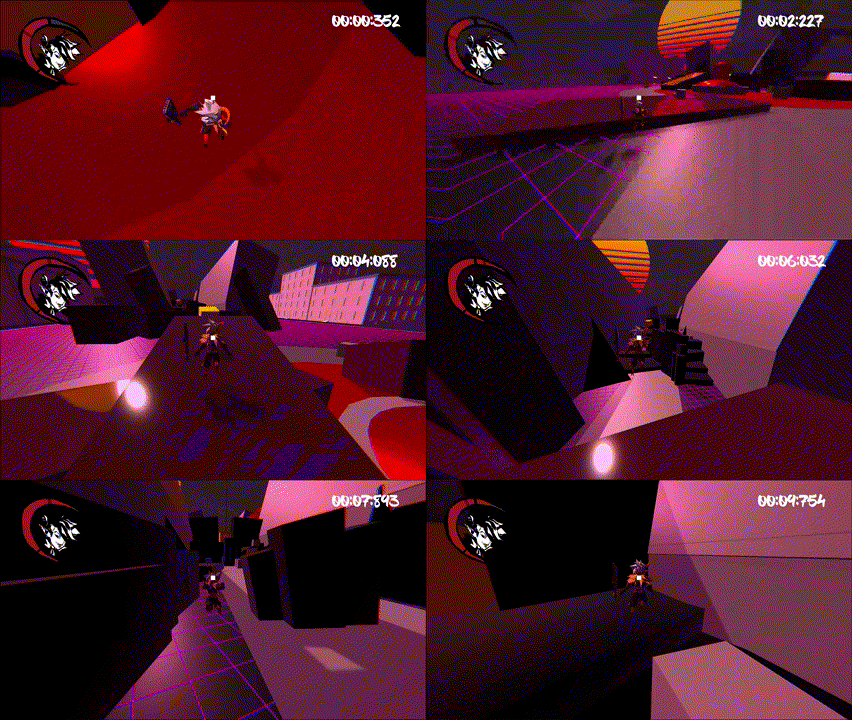
To meet production deadlines without compromising quality, some sword mechanics were scaled back. While early concepts included an extensive array of abilities, not all fit cohesively into the final design. Instead, the focus shifted to perfecting a core set of versatile mechanics, such as wall-slashing and air-dashing. By narrowing the scope, these features could be polished extensively, ensuring they felt impactful and satisfying to use, while also maintaining the game’s fast-paced rhythm.
Playtesting proved invaluable during the polishing phase, offering insights into how players interacted with the game’s mechanics. Feedback revealed areas where speed felt unintuitive or difficult to control, leading to tweaks in how momentum and movement worked. These changes helped create smoother, more fluid traversal. Enemy behavior was also revised based on playtester feedback, ensuring enemies posed a meaningful challenge without disrupting the game’s flow. At a later level, we experimented with having enemy gates, a wall-stopping progress that will disappear once all enemies are defeated. This was a risky feature since it forced the player to stop the momentum, going against the main idea of speed being good.


The final stages of development focused on integrating all these refinements into a cohesive, polished experience. Levels were revisited to ensure they encouraged creative use of mechanics, and transitions between combat and movement were smoothed to maintain a consistent flow. Visual and audio elements were enhanced to provide clear feedback during high-speed gameplay. The result was a tightly designed game that delivered on its vision of fast, fluid, and strategic action, balancing accessibility with depth.
